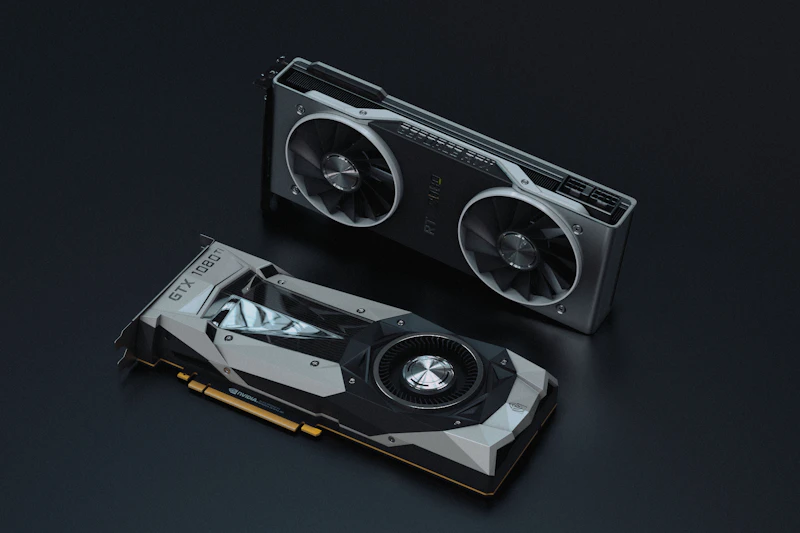
Nvidia RTX 5070 vs AMD RX 9070 XT: GPU Comparison
The mid-range GPU battle of 2026. We tested both cards across 15 games, ray tracing, AI features, and creator workloads to find the best value.
BestElectronicsReviewed.com is a participant in the Amazon Services LLC Associates Program. We may earn a commission from qualifying purchases made through links on this page, at no extra cost to you.
The mid-range GPU segment is where most gamers shop. The Nvidia RTX 5070 and AMD RX 9070 XT compete directly at the $500-600 price point, each offering compelling performance for 1440p and entry-level 4K gaming. We tested both across 15 games and several creator workloads.
Rasterization Performance
In traditional (non-ray-traced) gaming at 1440p, the AMD RX 9070 XT holds a slight advantage:
Across our 15-game benchmark suite at 1440p maximum settings:
- AMD RX 9070 XT: Average 112 FPS
- Nvidia RTX 5070: Average 105 FPS
The 9070 XT leads by approximately 7% in raw rasterization. In individual titles, the margin varies from near-parity (Cyberpunk 2077, Baldur's Gate 3) to a 15% AMD advantage (Helldivers 2, Starfield).
At 4K, the performance gap narrows to 3-5%, with both cards requiring DLSS/FSR to maintain playable framerates in demanding titles.
Winner: AMD RX 9070 XT for rasterization.
Ray Tracing
Nvidia's ray tracing performance remains a generation ahead of AMD's:
At 1440p with ray tracing enabled:
- RTX 5070: Average 82 FPS with DLSS 4
- RX 9070 XT: Average 61 FPS with FSR 3.1
The RTX 5070 delivers 34% higher performance in ray-traced games. In demanding titles like Cyberpunk 2077 Overdrive mode and Alan Wake 2, the Nvidia advantage exceeds 40%.
Winner: Nvidia RTX 5070, significantly.
DLSS 4 vs FSR 3.1
Nvidia DLSS 4: Multi-frame generation creates additional frames using AI, dramatically boosting framerates. The quality of AI-upscaled frames is excellent — artifacts are rare and barely noticeable in motion. Frame generation adds latency, partially offset by Reflex.
AMD FSR 3.1: Frame generation with improved quality over FSR 3.0. Open-source and available on both AMD and Nvidia hardware. Image quality is good but slightly behind DLSS in fine detail and artifact reduction.
Winner: Nvidia DLSS 4 for quality. AMD FSR for openness and compatibility.
AI and Creator Workloads
RTX 5070: CUDA cores and Tensor cores accelerate AI workloads, Stable Diffusion image generation, video upscaling (RTX Video Super Resolution), and NVENC encoding for streaming and video export.
RX 9070 XT: ROCm support for AI workloads is improving but still trails CUDA in software compatibility. Fewer AI tools natively support AMD hardware.
For content creators who use Adobe Premiere Pro, DaVinci Resolve, or AI image generation, the RTX 5070 offers meaningfully better acceleration.
Winner: Nvidia RTX 5070 for AI and creator workloads.
Power Consumption
RTX 5070: 250W TDP RX 9070 XT: 280W TDP
The Nvidia card draws 30W less while delivering comparable or superior performance in most scenarios. Over a year of daily gaming, this translates to approximately $15-25 in electricity savings.
Winner: Nvidia RTX 5070 for efficiency.
VRAM
RTX 5070: 12GB GDDR7 RX 9070 XT: 16GB GDDR6
AMD's 4GB VRAM advantage is increasingly relevant as game textures and assets grow. At 4K with ultra textures, some games already exceed 12GB VRAM. The 16GB buffer provides more headroom for future games and higher resolution texture packs.
Winner: AMD RX 9070 XT for VRAM capacity and future-proofing.
Price
RTX 5070: $549 MSRP (street price $550-600) RX 9070 XT: $499 MSRP (street price $500-550)
Winner: AMD RX 9070 XT for price.
The Verdict
Buy the Nvidia RTX 5070 if: You play ray-traced games, use AI or creator tools, value power efficiency, and want DLSS 4's superior upscaling.
Buy the AMD RX 9070 XT if: You prioritize raw rasterization performance, want 16GB VRAM for future-proofing, and prefer the lower price.
For most gamers, the AMD RX 9070 XT offers better value. For gamers who prioritize ray tracing and creators who rely on CUDA-accelerated tools, the RTX 5070 is worth the premium.
As an Amazon Associate, BestElectronicsReviewed earns from qualifying purchases.
Recommended Products
Top picks from our buying guides
Related Articles
eero Pro 6E vs Nest WiFi Pro: Mesh Router Comparison
Two premium mesh router systems compete for your home network. We tested coverage, speed, setup, and smart home integration in a 2,400 sq ft home.
ComparisonsGuide: OLED vs Mini-LED Monitors: Which Display Is Better in 2026 (This Week)
Guide: OLED vs Mini-LED Monitors: Which Display Is Better in 2026 (This Week) — expert analysis and tested recommendations from BestElectronicsReviewed.
ComparisonsUpdated: OLED vs Mini-LED Monitors: Which Display Is Better in 2026
Updated: OLED vs Mini-LED Monitors: Which Display Is Better in 2026 — expert analysis and tested recommendations from BestElectronicsReviewed.